
If you’re new to the world of plastic container manufacturing, you’ve probably already come across the acronym EBM. It stands for Extrusion Blow Molding, one of the most widespread technologies for making bottles, jerrycans, and hollow plastic containers.
In this guide, we’ll walk step by step through how the process works in each of its phases, the blow-moldable plastic materials used, the advantages and limitations, and how it differs from other plastic processing techniques such as injection molding or traditional extrusion.
What is Extrusion Blow Molding (EBM)
Extrusion blow molding, is a plastics processing technology used to produce items such as bottles or containers. The operating principle is relatively simple: a tube of molten plastic material, called a parison, is enclosed inside a mold and then inflated with compressed air until it adheres to the walls of the mold cavity, taking on its shape.
Thanks to its versatility and productivity, this technology is today one of the most widely used processes for producing rigid hollow packaging, finding application across numerous sectors, including food, cosmetics, detergents, industrial, and pharmaceutical.
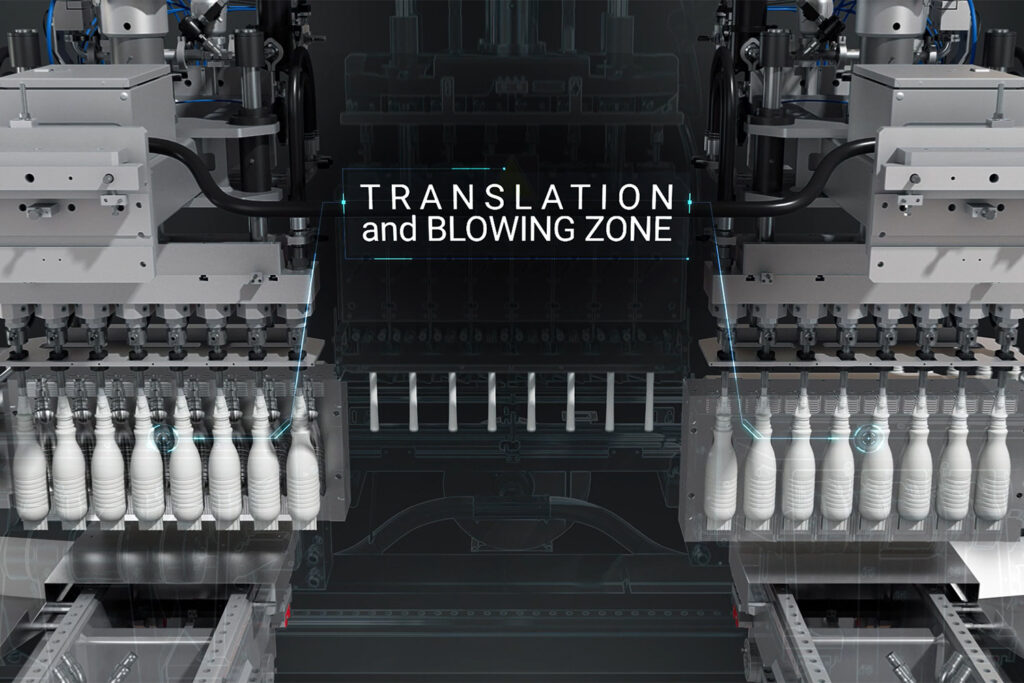
How the Blow Molding Process Works: Step by Step
The extrusion blow molding process can be broken down into 8 main phases.
1. Raw Material: Plastic Pellets
The entire process starts with plastic granules (known in technical jargon as pellets), the form in which most thermoplastic resins used in extrusion blow molding are supplied. These are small solid grains, typically a few millimeters in diameter, obtained upstream by petrochemical producers through polymerization and primary extrusion processes.
This granular form is what ensures precise dosing, a steady flow in the hopper, and uniform melting in the following stages. At this stage, in addition to virgin resin, PCR material pellets or color masterbatch may already be blended in, according to the percentages specified in the production recipe. The pellets are loaded into the extruder hopper, from which they descend by gravity toward the plasticizing screw.
2. Plasticization, Melting, and Parison Formation
The material moves along the extruder screw, where it melts due to the heat from the electric heating elements and mechanical friction. The temperature profile is adjusted according to the polymer to achieve an adequate viscosity and avoid defects in the parison, such as thickness variations or weak points.
The molten material then passes through the die, which defines its outer diameter, and the pin (or mandrel), which forms the annular passage and controls its thickness. The combination of die and pin produces a continuous hollow tube of molten plastic, called a parison. The thickness of its walls can be varied along its length to reinforce the areas of the container most subject to stress, such as the base and handling areas.
For the production of canisters or containers with asymmetric geometries, it is advisable to implement a parison radial adjustment system (PRA), which uses a deformable die made of a special alloy that can be electrically adjusted during extrusion. By modifying the die’s geometry and the concentricity between pin and die, the system allows radial control of the parison’s thickness, ensuring more precise and uniform material distribution even in complex geometries, such as those of canisters.
3. Mold Closing and Pinch-Off
As soon as the parison reaches the required length, the mold — made up of two halves — closes rapidly around it. During closing, the mold’s sharp edges cut the top and bottom ends of the parison (the pinch-off phase), sealing it hermetically inside the cavity and already defining, at this stage, the outer shape of the container’s future base.
4. Blowing and Shaping
At this point, compressed air comes into play: it is injected inside the parison through a blow nozzle. The air pressure causes the still-hot material to expand against the inner walls of the mold, until it faithfully reproduces every detail of the geometry — threads, handles, decorative reliefs, or embossed logos. Pressure is maintained for a few moments to ensure the material adheres perfectly to the mold.
5. Cooling
The bottle remains under pressure inside the mold, whose walls are cooled internally, until the material has solidified enough to hold its shape stably. Cooling time has a direct impact on the speed of the production cycle and is generally the longest phase of the entire process, which is why the efficiency of the cooling system is a key factor in mold design. In this regard, Techne implemented a compressed-air recirculation system in 2004 that transfers heat outward, speeding up internal cooling times.
6. Mold Opening and Extraction
Once the piece reaches a temperature sufficient to ensure dimensional stability, the mold opens and the container is extracted, moving on to the trimming (deflashing) phase.
7. Trimming and Finishing
The freshly extracted piece still has flash — excess material at the pinch points. This is removed through an automated trimming phase, which brings the container to its final shape. The scrap material from this operation is ground up and reintroduced into the production cycle, helping to reduce process waste.
8. Pickup and Output Conveying
Once finished, the bottle is picked up by a picker (an automated gripping system) that places it precisely on the output conveyor belt. From here, the container proceeds to the next stages of the production line, such as quality control, secondary packaging, or storage.
The Main Variants of Blow Molding
Under the blow molding umbrella, there are actually several technologies, each suited to specific production needs:
- Extrusion Blow Molding (EBM): the variant described in this guide, ideal for high volumes of bottles and canisters, with contained mold costs.
- Injection Blow Molding (IBM): the parison is first injection-molded onto a core rod and then blown in a second mold. It ensures greater dimensional precision, particularly suited to small containers such as pharmaceutical bottles.
- Injection Stretch Blow Molding (ISBM): used mainly for PET bottles, it involves axial stretching of the preform before blowing, improving the mechanical properties and transparency of the final product.
Materials Used in Extrusion Blow Molding
The polymers most commonly processed with this technology are:
- HDPE (High-Density Polyethylene): the most widespread for detergent bottles, canisters, and industrial containers, thanks to its chemical and mechanical resistance.
- PP (Polypropylene): valued for its heat resistance, often used in the food and automotive sectors.
- PVC: historically used for certain specific applications, now declining for regulatory and environmental reasons.
- PCR (Post-Consumer Recycled plastic): increasingly used blended with virgin resin, to meet sustainability needs and regulatory requirements regarding recycled content in packaging.
Advantages of Blow Molding
Compared to other plastic processing technologies, EBM offers some distinctive advantages:
- Low equipment costs: extrusion blow molds are generally cheaper than injection molds.
- Geometric flexibility: it’s possible to create complex shapes, integrated handles, and highly variable volumes, from small bottles to canisters holding dozens of liters.
- Efficiency at high volumes: suited to mass production with fast cycles and high repeatability.
- Thin walls and lightness: allows the container’s weight to be optimized while still maintaining good structural strength.
Limitations of the Technology
Like any manufacturing process, extrusion blow molding has some limitations:
- Lower dimensional precision compared to injection molding, especially on very narrow necks and threads.
- Less suitable for very small bottles with a capacity of less than 60 ml.
- Less suitable for thick walls or geometries with complex internal walls, where other technologies are more effective.
Blow Molding, Injection Molding, and Plastic Extrusion: Key Differences
It’s common to confuse extrusion blow molding with other processes that share part of the name or physical principles:
- Plastic extrusion (without blowing) produces continuous profiles with a constant cross-section — pipes, gaskets, sheets, profiles — without the inflation step inside a closed mold. Extrusion blow molding only shares the first phase with it (formation of the molten parison), then adds the blowing step that creates the hollow object.
- Injection molding injects molten polymer directly into a closed cavity under high pressure, producing solid parts or parts with internal geometries defined by the mold itself, without needing compressed air to form the cavity.
Understanding these differences is useful for navigating the various options available when deciding how to produce plastic packaging or a component, since each technology best suits different needs in terms of volumes, geometries, and budget.
Typical Applications of Extrusion Blow Molding
Thanks to its versatility, blow molding is used across numerous sectors:
- Food & dairy: bottles for beverages, oil, milk, and other food liquids.
- Detergents & home care: bottles for detergents, fabric softeners, and cleaning products.
- Cosmetics & personal care: containers for shampoo, creams, and hygiene products.
- Chemicals: canisters and drums for transporting chemicals, lubricants, and technical liquids.
- Lubricants: tanks, air ducts, and other non-structural hollow components.
- Pharmaceutical: IV bags or pill containers.
In Summary
Extrusion blow molding is today one of the most versatile and cost-effective technologies for producing hollow plastic containers at medium-to-large volumes. Understanding its phases is the first step in assessing whether this technology is the best fit for your production needs, perhaps comparing it with alternatives such as injection blow molding or injection molding, depending on the type of container, required volumes, and available budget.


