
Blow molding is the process used to produce hollow plastic containers by blowing air into a thermoplastic polymer. The three main technologies – EBM, IBM, and SBM – differ in production cycle, materials, and size range.
- EBM – Extrusion Blow Molding
- IBM – Injection Blow Molding
- SBM – Stretch Blow Molding
How do the EBM, IBM, and SBM processes work?
EBM | Extrusion Blow Molding
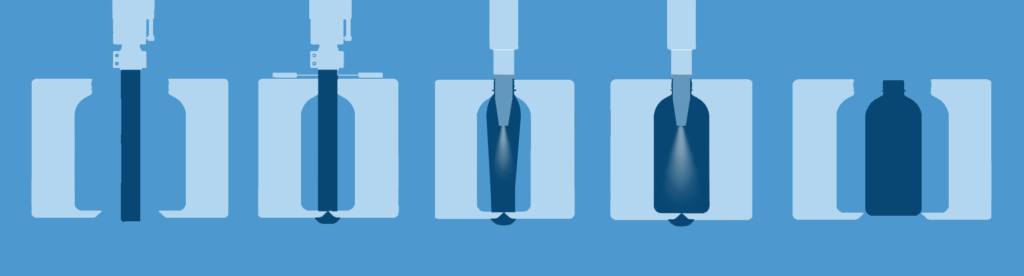
An extremely versatile technology, suitable for medium to large volume bottles and jerrycans, including those with integrated handles or multi-layer structures.
- Materials: HDPE, LDPE, PP, PVC, PCR.
- Sizes and capacities: from approximately 100 ml up to 30–50 L.
- Applications: food, cleaning products, cosmetics, chemical, agrochemical, automotive, and coolant containers.
Process: The granules are melted in the extruder and pushed through the die to form a continuous tube (parison). The mold closes around the hot parison, and compressed air expands it against the cooled mold walls. After solidification, the part is ejected and trimmed. Parison thickness control allows reinforcement of critical areas (bottom, shoulders, handle).
IBM | Injection Blow Molding
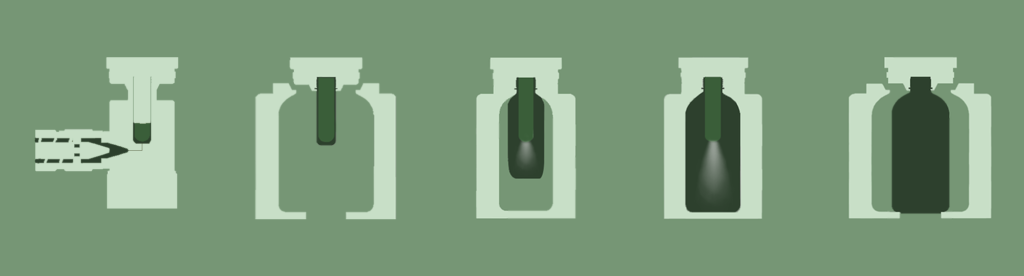
Recommended for small formats that require maximum neck precision and high-quality finish.
- Materials: PP, HDPE, PETG.
- Sizes and capacities: from approximately 5 ml to 1 L.
- Applications: pharmaceutical, personal care, dietary supplements.
Process: An injection-molded preform is created around a core, precisely defining the neck. The preform is then transferred to the blow mold and inflated to its final shape. A trim-free process, ideal for high aesthetic quality.
SBM | Stretch Blow Molding
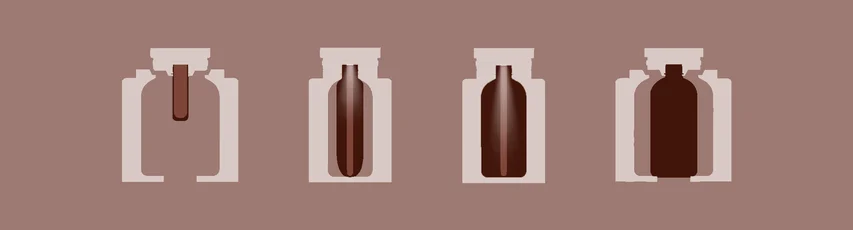
The reference technology for PET bottles with high mechanical performance and transparency.
- Materials: PET.
- Sizes and capacities: from approximately 100 ml to 5 L (typical beverage bottles: 0.33–2 L).
- Applications: water, soft drinks, edible oils.
Process: The PET preform is heated, placed into the mold, axially stretched by a rod, and simultaneously blown radially. The biaxial stretching orients the molecules, improving strength and rigidity.
Advantages of EBM Technology Compared to IBM and SBM.
- Greater design freedom → allows integrated handles and complex geometries (fewer constraints compared to IBM and SBM).
- Higher material versatility → easily works with HDPE, PP, and multilayer structures (SBM is mainly for PET).
- More cost-effective for large volumes → ideal and cheaper for medium-to-large containers (jerrycans, industrial bottles).


