
The Home Care sector represents one of the most complex and dynamic markets in the field of plastic packaging. Bottles for detergents, fabric softeners, degreasers, bleach, household and car cleaning products must simultaneously meet different requirements: chemical resistance, safety in use, ergonomics, aesthetic quality, cost optimization and increasing attention to sustainability.
The design of a detergent container is therefore not limited to choosing a shape or volume, but involves a series of technical assessments that start from the formulation of the product being contained and extend all the way to the packaging production process.
For this reason, in the Home Care sector, extrusion blow molding technology plays a strategic role: it makes it possible to produce containers with complex geometries, different levels of rigidity and flexibility, multilayer structures and customized solutions according to the requirements of the final product.
Types of Home Care products
Among the main applications in this sector are:
- liquid detergents for household cleaning;
- liquid laundry detergents;
- fabric softeners;
- bleach and hypochlorite-based products;
- surface and toilet cleaners;
- professional degreasers;
- concentrated products for domestic or industrial use.
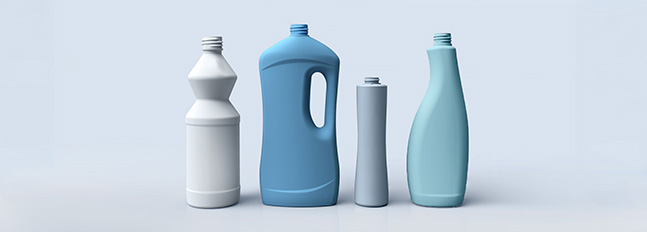
A bottle intended for a spray cleaner, for example, must provide different characteristics compared to a container for concentrated detergent or a bleach container.
The following requirements therefore vary:
- the required chemical resistance;
- the rigidity of the structure;
- the deformability of the container;
- the ability to withstand loads during transportation and storage;
- the aesthetic quality required by the final market.
Container design must therefore be developed by considering the entire product life cycle: filling, handling, distribution and use by the consumer.
The choice of plastic materials
Plastic materials used in the detergent sector are selected according to the product formulation, the performance requirements of the container and the production objectives.
The most commonly used materials include:
- HDPE is one of the most widely used materials for the production of bottles and containers for detergents, thanks to its high chemical resistance, rigidity and ability to provide good performance even with aggressive products.
- HMWPE (High Molecular Weight Polyethylene) is often selected for applications requiring greater mechanical strength, high impact resistance and improved performance in medium- to large-sized containers.
- LDPE is used when greater flexibility, softness or controlled container deformation is required, for example in certain types of squeezable bottles.
- PP is used in applications requiring greater rigidity, thermal resistance or specific aesthetic and functional characteristics.
The choice of material must also take into account the interaction between the container and the chemical product. Some formulations containing surfactants, solvents, oxidizing agents or alkaline substances can affect polymer behavior over time, making correct material selection and wall-thickness design essential.
Monolayer and Coextrusion: different solutions for different requirements
Extrusion blow molding technology makes it possible to produce containers both in a monolayer configuration and through multilayer structures. Coextrusion solutions, up to COEX-6 configurations, allow different materials to be combined within the same container.
This technology offers several advantages:
- possibility of incorporating recycled material into the core layer;
- reduction in virgin material consumption;
- cost optimization;
- maintenance of the aesthetic quality of the external surfaces;
- development of structures with specific characteristics.
In the Home Care sector, coextrusion is often used to achieve the best balance between performance, sustainability and economic competitiveness. For example, a multilayer structure can make it possible to use recycled material while maintaining suitable inner and outer layers for contact with the detergent, together with an external surface offering high aesthetic quality.
The optimal configuration always depends on the product being contained, the bottle volume, the required level of sustainability and the standards of the final customer.to, dal volume del flacone, dal livello di sostenibilità richiesto e dagli standard del cliente finale.
Container quality depends on process control
In extrusion blow molding, the final quality of the container depends on the machine’s ability to precisely control every stage of the process. The key parameters include:
- temperature and homogenization of the plastic material;
- control of parison wall-thickness distribution;
- cooling management;
- mold precision;
- repeatability of the production cycle.
Wall-thickness distribution is particularly important in the detergent sector. A container that is too lightweight can compromise rigidity and mechanical resistance, while excess material increases costs and environmental impact. Accurate control therefore makes it possible to obtain containers that are lighter, stronger and more consistent in terms of quality.
Complex shapes, ergonomics and integrated handles
One of the main advantages of extrusion blow molding is the ability to produce containers with highly customized geometries.
In the Home Care sector, solutions such as the following are widely used:
- ergonomic bottles with integrated handles;
- containers with built-in handles;
- shapes designed to improve grip and everyday use.
Mold design and process control make it possible to achieve complex geometries while maintaining wall-thickness uniformity and industrial productivity. For brands, packaging therefore becomes not only a functional element, but also a tool for brand recognition at the point of sale.
Format change, color change and production flexibility
Packaging manufacturers working for multiple brands or product categories must be able to manage frequent production changes. Plant flexibility therefore becomes a key factor.
Dedicated technological solutions make it possible to reduce:
- format changeover times;
- cleaning times;
- scrap during material or color changes;
- non-productive downtime.
The surface treatment of extrusion head components, such as PVD (Physical Vapor Deposition) coating, can also help reduce polymer adhesion to metal surfaces, facilitating cleaning operations and improving color change management.
To reduce mold changeover times, Techne Packaging has developed a range of advanced solutions such as quick couplings, lifting platforms, magnetic plates and guided systems. Thanks to these solutions, the format changeover can be completed in 2–2.5 hours, or even in just 1.5 hours with the Plus version.
In Mold Labeling: integrated aesthetics and functionality
For premium applications or where product image plays an important role, In Mold Labeling (IML) represents a technological solution that makes it possible to integrate the label directly into the container during the production process, achieving:
- high graphic quality;
- greater resistance to water and detergents;
- elimination of certain subsequent labeling operations;
- possibility of decorating surfaces with complex geometries.
In the Home Care market, where packaging often needs to communicate quality and differentiation, IML represents an interesting value-added element.
Sustainability: less material, greater efficiency
Sustainability is now one of the main development drivers for detergent packaging. Companies are working on several fronts:
- reduction of container weight;
- increased use of PCR recycled material;
- optimization of energy consumption;
- improved recyclability of the finished product.
Extrusion blow molding technology makes it possible to address these aspects through more precise process control, optimized multilayer structures and designs focused on lightweighting.
How Techne Packaging Works
Techne Packaging electric blow molding machines are developed for the production of plastic bottles, containers and cans intended for various industrial sectors, with particular expertise in the Home Care segment.
Each project starts with an analysis of the customer’s specific requirements:
- container type;
- material to be processed;
- production volumes;
- required level of automation;
- aesthetic and functional requirements.
Techne Packaging develops customized extrusion blow molding machines to transform complex production requirements into reliable, competitive containers that are ready for the market.


